Nissei ASB, Japan
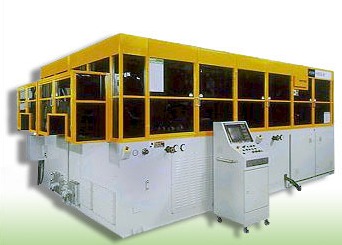
HSO Series
Two-step reheat machines producing heat stabilized PET bottles by the Double Blow method.
In broad terms there are two methods for producing heat stabilized bottles, the Single Blow and the Double Blow systems.
Single Blow: this technique can be applied on a conventional one-step ASB machine. The PET container is blown inside a heated blow mold. This raises the level of crystallinity of the PET, and also relaxes some of the stresses induced in the PET by the stretching process so that the amount by which the bottles shrink when hot filled is reduced. The temperature of the mold is limited by the need to ensure that bottles on leaving the blow mold are rigid & will not be subject to deformation. Even using special in-mold cooling systems, "single blow" methods can only raise service temperatures to about 83°C (after storage).
Double Blow: specially developed reheat blow molding machines are required to make Double Blow bottles. An oversized bottle is blown which is then subjected to heat setting followed by a stress relieving process, before being blown for a second time to form the finished container. Double Blow bottles have higher levels of crystallinity plus very low levels of residual stress, and can be hot filled at temperatures up to 87°C (after storage).
Note that heat resistance is lowered if heat stabilized bottles are stored under conditions of high temperature and humidity. This phenomenon applies to both the Single and Double Blow methods. The hot filling temperatures quoted above are for bottles that have been stored at 40°C and 90% RH for 24 hours.
The Six Steps of the Process
- 1 Preform Reheat Conditioning: The preform is heated to the optimal temperature for blowing.
- 2 Primary Blow Molding: The hot preform is stretch blown in the primary mold to form an oversize bottle.
- 3 Primary Heat Processing: Heat setting is done by a direct contact method.
- 4 Secondary Heat Processing: The bottle is indirectly heated in an oven to induce stress relaxation and promote crystal growth.
- 5 Final Blow Molding: The shrunken and slightly deformed bottle is blow molded to the product's final shape.
- 6 Bottle Ejecting: The finished bottle is ejected from the machine.
Characteristics
This two-step reheat blow molding machine produces heat-resistant containers. Preforms go through carefully controlled heating & blowing processes, consisting of reheating, primary blow, primary heating, secondary heating, and final blow. All the specifications demanded by the industry for heat-resistant PET containers are met or excelled. With a shorter cycle time, the HSO Series has a compact design that revolutionizes heat-resistant bottle production systems. When used together with the PM Series of preform molding machines and the CM Series neck crystallization machines, the result is an integrated production line that delivers defect-free, cost-effective high heat-resistant containers.
- Product Shape
- Heat-resistant PET bottles with round or rectangular cross-sections.
- Application
- Heat-resistant PET bottles for beverages (carbonated beverages, fruit juice, tea, mineral water, etc.).
- Size and Quantity
- Depending on type and bottle application, sizes range from 500 ml to 2 litres. The output varies depending upon the machine, bottle size and design.
Model Line-Up
- HSO-3
- HSO-4
- HSO-6
- HSO-8N
- HSO-12L